Executive Summary
The search query “lorem ipsum dolor means” represents a fascinating duality in internet search behavior. It’s not merely a translation request but a linguistic bridge connecting two distinct groups: everyday internet users and professional practitioners (designers, developers, publishers).
On the surface, this string of scrambled Latin is a standard placeholder in digital design. However, deeper analysis reveals it as a marker for cognitive gaps, professional practices, and technological history in the modern web experience.
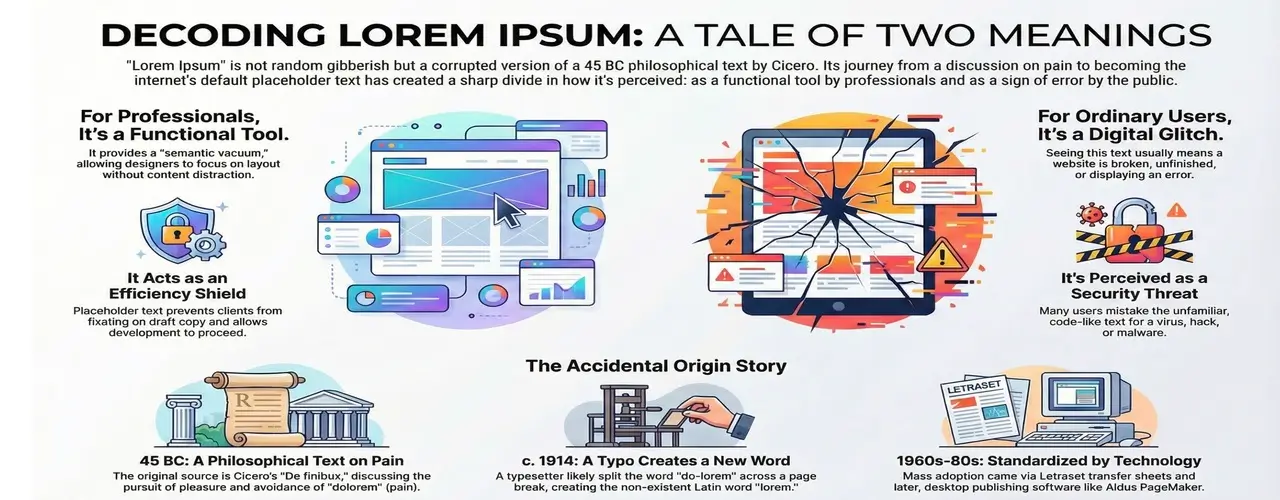
For practitioners, this text is a formal tool stripped of semantic interference—a living fossil from the transition of typography to digitization. Their search intent often involves tracing the tool’s roots, reflecting on design methodologies, and pursuing typographic aesthetics.
For ordinary users, this text is often not only meaningless but potentially alarming. It typically appears when a website’s “scaffolding” is exposed due to an error, symbolizing a breakdown in the digital experience. User intent mixes curiosity about an unknown language, concern that “garbled text” indicates a problem, and an instinctual attempt to decode a perceived “secret message.”
Chapter 1: Linguistic Archaeology — From Cicero to Typesetters
To understand why users search for “what this means,” we must first establish the text’s true nature. It is not randomly generated gibberish but a linguistic relic shaped by time.
1.1 Philosophical Roots: The Dialectic of Pain and Pleasure
Although widely regarded as meaningless nonsense, the text possesses a distinguished philosophical lineage. It derives directly from “De finibus bonorum et malorum” (“On the Ends of Good and Evil”), an ethical treatise written by the Roman statesman and philosopher Marcus Tullius Cicero in 45 BC.
Specifically, the standard placeholder text is a scrambled variant of sections 1.10.32 and 1.10.33 of Book I. In this chapter, Cicero explores Epicurean and Stoic views on pain (dolor) and pleasure. This discovery is credited to Richard McClintock, a Latin scholar at Hampden-Sydney College, who traced the obscure Latin word “consectetur” to its source.
For users searching for “means,” there is a profound irony: the text used to fill space and symbolize “meaninglessness” originally discussed the profound human condition of pain itself.
The original Latin reads:
“Neque porro quisquam est, qui dolorem ipsum quia dolor sit amet, consectetur, adipisci velit, sed quia non numquam eius modi tempora incidunt ut labore et dolore magnam aliquam quaerat voluptatem.”
The 1914 translation by H. Rackham:
“Nor is there anyone who loves, or pursues, or desires to obtain pain of itself, because it is pain, but occasionally circumstances occur in which toil and pain can procure him some great pleasure.”
Thus, when a designer fills a beautiful web layout with this text, they are unknowingly using philosophical speculation on “toil and pain” to build visual pleasure.
1.2 The Collapse of Text: The Loeb Classical Library Hypothesis
If Cicero’s original text was coherent, why does “Lorem Ipsum” read like broken gibberish?
McClintock proposed the compelling “Loeb Hypothesis” to explain the text’s corruption. The physical source was likely the 1914 Loeb Classical Library edition of De Finibus. In this edition, the Latin text appeared on left (even-numbered) pages. On page 34, the text breaks off at the word “dolorem” due to a page break:
- Page 34: ”…Neque porro quisquam est qui do-” (cut off by hyphen)
- Page 36: “lorem ipsum quia dolor sit amet…” (continues on next page)
It is speculated that an unknown typesetter, when creating a type specimen book, took page 36 as a sample, thereby losing the “do-” prefix and truncating subsequent grammatical structures. This accident turned a coherent sentence into a pile of characters.
This historical accident created an etymological anomaly: “Lorem” does not exist in Latin; it is the severed remnant of “Dolorem” (the accusative form of “pain”). This explains why translation tools fail to produce meaningful results—the “meaninglessness” is not random but a result of physical text corruption.
1.3 The Functionality of Semantic Vacuum
For practitioners, understanding this “semantic vacuum” is key to mastering the tool. If real, meaningful text (like news articles or novels) is used as a placeholder, the reader’s attention is instinctively drawn to the content—a variation of the psychological “Stroop Effect.”
“Lorem Ipsum” succeeds because it retains the texture of language while stripping away information:
- Natural Letter Distribution: Unlike simple repetition (e.g., “AAAAA”), Lorem Ipsum simulates the natural frequency of vowels and consonants, possessing varying word lengths and natural sentence structures.
- Visual Grayness (Typographic Color): It generates an even, natural “gray” on the page, allowing designers to objectively evaluate layout balance without being distracted by word meanings.
Chapter 2: The Practitioner’s Perspective — Evolution of Tools & Methodological Debates
When designers or developers search for these terms, their intent goes beyond literal meaning to workflow application, history, and industry debate.
2.1 From Lead to Pixel: A History of Standardization
“Lorem Ipsum” became the industry standard not by chance, but by surviving three revolutions in printing technology:
-
Typesetting Era (1500s - 1950s): While legends trace it to the 16th century, its widespread standardization is more modern. Ready-made galley proofs improved efficiency in physical typesetting.
-
Dry Transfer Era (1960s): A key moment for mass adoption. The British company Letraset released dry-transfer sheets pre-printed with Lorem Ipsum. Designers could simply rub the text onto their drafts, moving it from the print shop to the designer’s desk.
-
Desktop Publishing Revolution (1980s - Present): With the release of Aldus PageMaker (predecessor to InDesign), Lorem Ipsum was hard-coded as the default placeholder. This cemented its status as the “default setting” for digital natives.
2.2 The “Content First” vs. “Design First” Debate
A significant portion of practitioner searches (e.g., “why designers use lorem ipsum” or “alternatives”) reflects a deep divide in design methodology.
The Critics (Content First):
With the rise of UX design, many argue that Lorem Ipsum represents “lazy design”:
- Disconnect from Reality: Lorem Ipsum blocks are uniform, whereas real client copy varies wildly. Interfaces designed with perfect placeholders often break when real content is inserted.
- Loss of Meaning: Design should serve content. Without knowing the content, information architecture cannot be properly constructed, reducing design to decoration rather than communication.
The Supporters (Design/Structure First):
Despite criticism, usage remains high due to its utility in decoupling processes:
- Avoiding Stakeholder Distraction: In reviews, clients often fixate on typos or tone in draft copy, ignoring layout and interaction. Lorem Ipsum shields against non-constructive feedback on content.
- Development Efficiency: In agile environments, content often lags behind development. Placeholders allow frameworks to be built without waiting for final copy.
Chapter 3: The Ordinary User’s Perspective — Confusion, Fear, and Misreading
Unlike practitioners, ordinary users searching for “lorem ipsum” are often experiencing cognitive dissonance.
3.1 The “Broken Web” and Virus Panic
For non-technical users, encountering unintelligible Latin often signals that “something is wrong.”
-
Troubleshooting Intent: Users see this text in neglected website templates, test emails, or erroneous pop-ups. Their search effectively asks, “Is this site broken?” or “Is this a mistake?”
-
Security Anxiety (The Virus Hypothesis): A surprising number of queries link “lorem ipsum” with “virus” or “hack.” When screens display unrecognizable “code-like” language accompanied by strange page behavior, users instinctively suspect malware. Fake virus warning pop-ups sometimes use sloppy code or placeholders, reinforcing this association.
3.2 Translation Attempts and Mysticism
Other users are driven by curiosity, attempting to translate the text in hopes of finding wisdom or a secret message.
- Translation Failure: Due to the text’s corruption (“Dolorem” to “Lorem”), translation tools often fail or output nonsense, driving users to search for manual explanations.
- Mysticism: In pop culture, obscure Latin is often linked to spells or secret societies. Users are often disappointed (or relieved) to find it is merely garbled philosophical text about pain.
Chapter 4: SEO and Data Perspective
From an SEO standpoint, “lorem ipsum” is a double-edged sword: a traffic source for some, a quality trap for others.
4.1 Keyword Intent Classification
- “lorem ipsum translation” — Ordinary User, Informational: Trying to understand the “gibberish.”
- “is lorem ipsum a virus” — Ordinary User, Informational: Safety check, seeking reassurance.
- “lorem ipsum generator” — Practitioner, Transactional/Tool: Looking for a tool to generate text for work.
- “lorem ipsum origin” — Mixed, Informational: Curiosity about history/trivia.
4.2 The Invisible SEO Killer: Soft 404s
For webmasters, leaving Lorem Ipsum on a live site is dangerous:
- Index Pollution: Search engines may classify pages full of placeholder text as “Low Quality” or “Thin Content,” dragging down domain authority.
- Soft 404 Errors: Google may identify these as non-real pages and remove them from the index.
- Bounce Rate: Users landing on a “broken” looking page will leave immediately, sending negative signals to algorithms.
Chapter 5: Global Perspective — The Limits of Latin
“Lorem Ipsum” is Eurocentric. For non-Latin scripts, it fails to function properly.
5.1 The CJK (Chinese-Japanese-Korean) Challenge
Latin visual density differs significantly from logograms (Chinese) or syllabaries (Kana):
- Texture Mismatch: Chinese characters are dense blocks; Latin has variable word lengths and more whitespace. Using Latin placeholders for a Chinese site leads to incorrect spacing and layout estimates.
5.2 Localized Placeholder Alternatives
Practitioners in other regions have developed their own placeholder cultures:
-
Chinese (Chinese Ipsum): The Thousand Character Classic, an ancient poem where no character is repeated, offers cultural depth and visual variety. Modern generators randomize common characters or mimic famous authors.
-
Japanese (Japanese Ipsum): Natsume Sōseki’s novel “I Am a Cat” (Wagahai wa Neko de Aru) is a standard placeholder because it is public domain and naturally mixes Kanji, Hiragana, and Katakana.
-
Russian (Cyrillic Ipsum): Known as “Ryba-text” (Fish text). Since Russian words are longer than English, using English placeholders often leads to broken layouts.
Chapter 6: Technical Implementation & Future
6.1 Generator Mechanics
Modern generators are not random string creators. They use a dictionary of approximately 200 Latin words (from Cicero) combined with sentence structure algorithms to ensure the output “looks” like language.
6.2 Generative AI: The End of Lorem Ipsum?
With LLMs like ChatGPT, the need for “dumb” placeholders may be diminishing:
- Context-Aware Placeholders: Designers can now generate “real” fake copy (e.g., “Write a 100-word intro for a fintech app”). This addresses the “Content First” dilemma by providing high-fidelity text early in the process.
“Lorem Ipsum” may eventually become purely a cultural meme or nostalgic symbol, surviving mainly in design history books.
Conclusion
The search query “Lorem Ipsum Dolor Means” is a window into the infrastructure of the internet:
- For historians, it represents a 2,000-year journey from Roman philosophy to digital code.
- For practitioners, it is a rational tool separating form from content.
- For users, it is a “glitch” in the matrix, revealing the skeleton of the web.
Ultimately, the meaning of Lorem Ipsum lies in its meaninglessness. In an age of information overload, it is the only text that demands no attention, sells nothing, and says nothing. It waits silently, holding the space for form, until the content arrives.